How to Increase Occupancy at Your Self-Storage Facility: 8 Proven Tactics
Management Software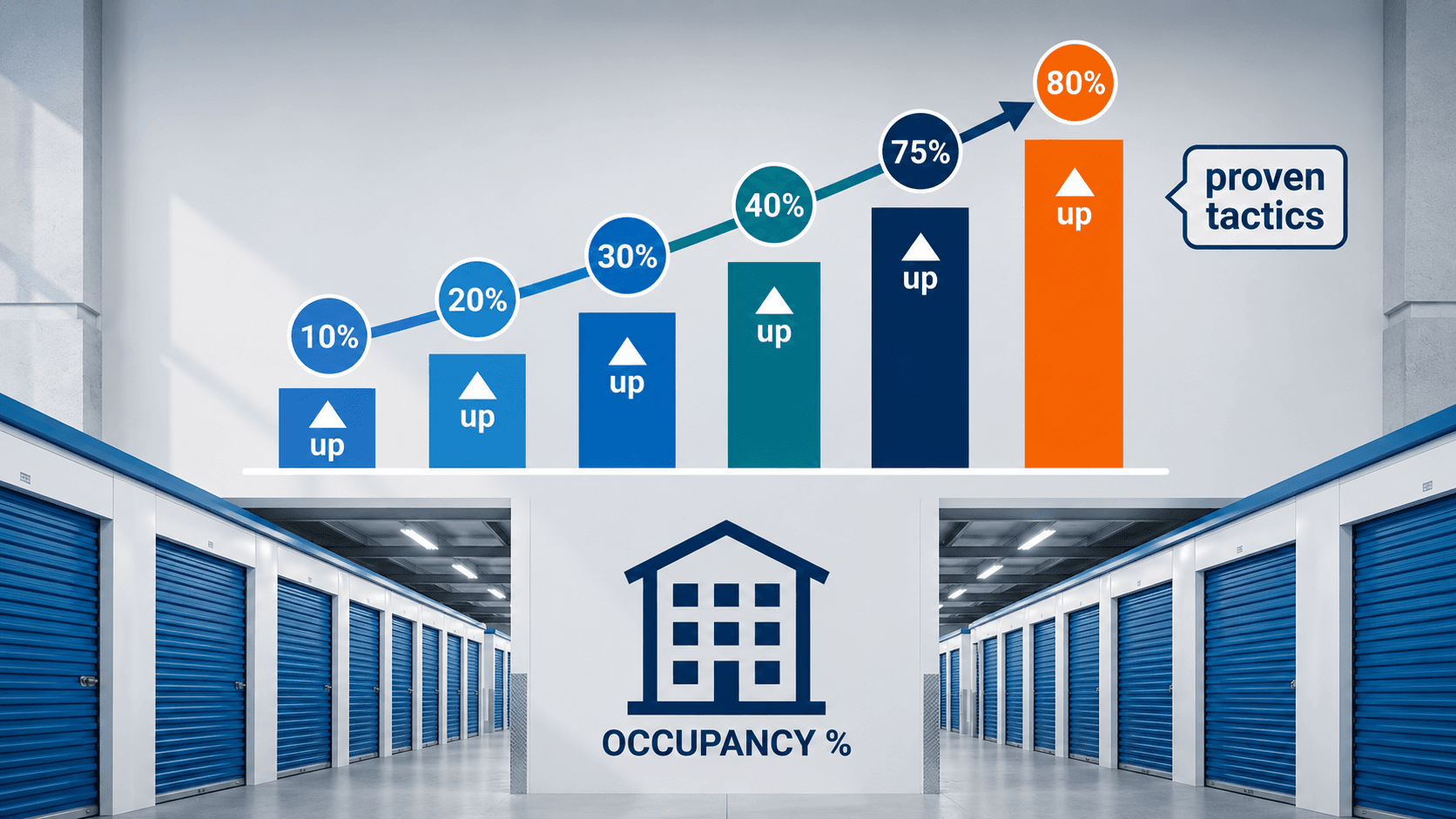
Every self-storage operator faces the same question every month: how do we fill more units? The answer is rarely a single big move. It is usually a series of unglamorous improvements compounded over time.
Occupancy is where every other operating decision shows up. It drives revenue, it determines refinance terms, and it is the metric every potential buyer looks at first. For most facilities, getting from 85 to 92 percent occupied is worth more than any other operational improvement on the table.
The market has tailwinds, but with more than 50,000 facilities in the United States, owners cannot rely on demand alone. The eight tactics below are the playbook the best operators run, year in and year out.
1. Master Local SEO and Your Google Business Profile
The vast majority of new tenants find a storage facility through a Google search. Studies of consumer search behavior show that around 80 percent of U.S. consumers search online for local businesses on a weekly basis (BrightLocal). For a query like "storage units near me," your Google Business Profile is doing more sales work than your website.
What to Get Right
- Claim and verify the profile. Confirm the business address, hours, phone, and website are accurate.
- Add real photos. Multiple exterior photos, interior hallway shots, the gate, the office, and signage. Profiles with photos consistently outperform profiles without.
- Pick the right primary category. "Self-storage facility" is correct. Avoid generic "storage company" or vague alternates.
- Use Google Posts. Free placement of move-in specials, new unit availability, and seasonal updates directly inside the listing.
- Get reviews. Tactics covered in section 6.
For broader marketing partner help, see our storage marketing and web vendors directory.
2. Make Online Reservations Frictionless
Once a prospective tenant lands on your website, every extra click between curiosity and signed lease is a chance to lose them. Modern storage management software platforms can take a tenant from search to signed contract in under five minutes when configured correctly.
The Online Rental Funnel That Actually Works
- Live unit availability and pricing visible without a phone call.
- Mobile-first design. Most tenants are searching from a phone in the middle of a move.
- Digital lease signing integrated with the management system.
- Automatic gate access provisioning so tenants can move in immediately after signing.
- Confirmation by both email and SMS so the tenant feels secure about the transaction.
Facilities that offer a complete online rental experience consistently report higher conversion rates than those requiring an in-person or phone-only signup.
3. Use Dynamic Pricing Instead of Static Rate Cards
A static rate card is the easiest pricing approach, and it is also the most expensive. Dynamic pricing, sometimes called rate management or revenue management, adjusts unit prices based on real-time supply and demand at your facility. When a 10x10 climate-controlled unit becomes scarce, the price for the remaining units rises automatically. When occupancy in a unit type is low, prices come down to drive move-ins.
Where the Money Is
- Higher rates on scarce inventory: When you have only two 10x20 units left, you should not be selling them at the same price as when you had twenty.
- Faster lease-up on slow-moving sizes: Lower prices on slow-moving inventory accelerate fill rate.
- Rate transparency: Online prospective tenants see real-time prices that reflect availability.
Most modern management platforms include dynamic pricing modules. Operators who turn them on typically see a 3 to 7 percent revenue uplift on the same occupancy.
4. Run the Right Move-In Specials, Not the Wrong Ones
Move-in specials work, but only certain kinds. The traditional "first month free" offer is the most common, and also the most overused. Better operators are mixing it with offers that protect long-term revenue.
Specials That Convert Without Wrecking Your Economics
- $1 first month: Captures the searcher who is comparing prices, with less revenue impact than truly free.
- Half-off first three months: Spreads the discount and increases the chance the tenant stays past their initial need.
- Prepay six months, get the seventh free: Locks in revenue and dramatically reduces churn.
- Lock and box bundle: Add a free disc lock and a moving-supplies kit. Higher perceived value, low marginal cost.
The trick is to track conversion and churn for each special separately. The "best" offer for your facility is whichever produces the highest 12-month tenant value, not whichever produces the most move-ins.
5. Capture Every Phone Lead
Even with strong online conversion, a meaningful share of inquiries still come by phone. Industry observers regularly note that small operators miss 20 to 40 percent of inbound calls because the office is closed, the staff is occupied, or the call comes after hours. Every missed call is a tenant going to a competitor.
How to Stop Missing Calls
- Call center coverage. Self-storage call centers like XPS Solutions answer your calls 24/7, qualify the lead, and book the unit directly through your management software.
- Live answering services. A simpler option that just routes calls to a real person who can take a message or transfer to your software.
- Voicemail-to-text with fast follow-up. If you cannot afford full coverage, set a 30-minute callback rule on every voicemail received during business hours.
The math here is clear: a single recovered call that converts to a $150 per month tenant for one year is worth $1,800. A small monthly call-center fee pays for itself many times over.
6. Build a Reviews Engine That Compounds
Online reviews are now one of the most influential factors in a tenant's decision. According to BrightLocal, around 87 percent of consumers read online reviews for local businesses (BrightLocal Local Consumer Review Survey). A facility with 50 reviews at a 4.8-star average will out-convert a facility with 5 reviews at a 4.9-star average, every time.
A Simple Process That Works
- Ask at the right moment. The day after move-in is the highest-conversion ask.
- Make it one click. Send a text or email with a direct link to your Google review form. Anything more friction-y will see a 90 percent drop-off.
- Respond to every review. Both five-star and one-star reviews. Responding shows future readers that you care, and Google appears to favor profiles with consistent owner responses.
- Track the cadence. Aim for a steady drip of new reviews. A facility that gets two new reviews a month will outperform one that got 50 reviews three years ago and none since.
7. Audit and Optimize Your Unit Mix
Many facilities operate with a unit mix that was decided at construction and has not been touched since. Demand patterns change. Markets evolve. The 10x30 units that were profitable in 2010 may now sit empty while the 5x10 units have a waiting list.
How to Run a Unit Mix Audit
- Pull occupancy by size category for the last 24 months. Look for sizes that have been below 70 percent occupied for more than a year.
- Pull lead and reservation data for sizes you do not have. If you are turning away three 5x5 inquiries a week, that is a clear demand signal.
- Convert underperforming sizes. Two 10x30 units can often be reconfigured into four 10x15 units with new partition walls. The construction cost is modest, and the revenue per square foot typically rises significantly.
- Add specialty units. Climate-controlled, drive-up, RV, and boat parking each have their own demand profiles. If your market shows demand and your facility has the footprint, conversion is one of the highest-ROI improvements you can make.
8. Reduce Move-Out Rate with a Real Retention Program
Most occupancy conversations focus on getting tenants in the door. The math is at least as compelling on the other side. Cutting your move-out rate by even one percentage point per month at a 500-unit facility is worth roughly five additional occupied units at any given time, or about $9,000 in annual revenue at a $150 average rate.
Retention Tactics That Work
- Loyalty discounts. A small rate hold or a discounted month at the 12-month mark can extend a tenant's stay by an average of six to nine months.
- Friction-free communication. Tenants who can pay, change cards, and get questions answered through a self-service portal churn less than tenants who have to call the office.
- Proactive condition checks. A polite text message after a heavy storm asking the tenant to check their unit signals that you care, and surfaces small problems before they become move-out reasons.
- Smart ECRI strategy. Existing customer rate increases done well grow revenue without spiking move-outs. Done poorly, they push out long-tenured customers who are hard to replace.
9. Final Word: Compounding Beats One Big Move
None of these tactics is a magic switch. Local SEO improvements take a few months to show in rankings. Reviews build over quarters, not days. A new unit mix takes a construction cycle to convert and another year to fill.
What works is running all eight in parallel and committing to them for at least a full year. Operators who do this consistently outperform their markets. Operators who chase one tactic at a time, abandon it after three months, and look for the next silver bullet usually end up frustrated.
Pick two of the eight to start with this quarter, set up tracking so you can measure the impact, and add the next two in 90 days. Done this way, an extra five to seven points of occupancy is a realistic 18-month outcome.
Looking for Management Software vendors?
Browse our directory of trusted management software providers for storage facilities.
View Management Software Vendors