Moving Supplies for Self-Storage: The Ancillary Revenue Most Owners Leave on the Table
Moving & Packing Supplies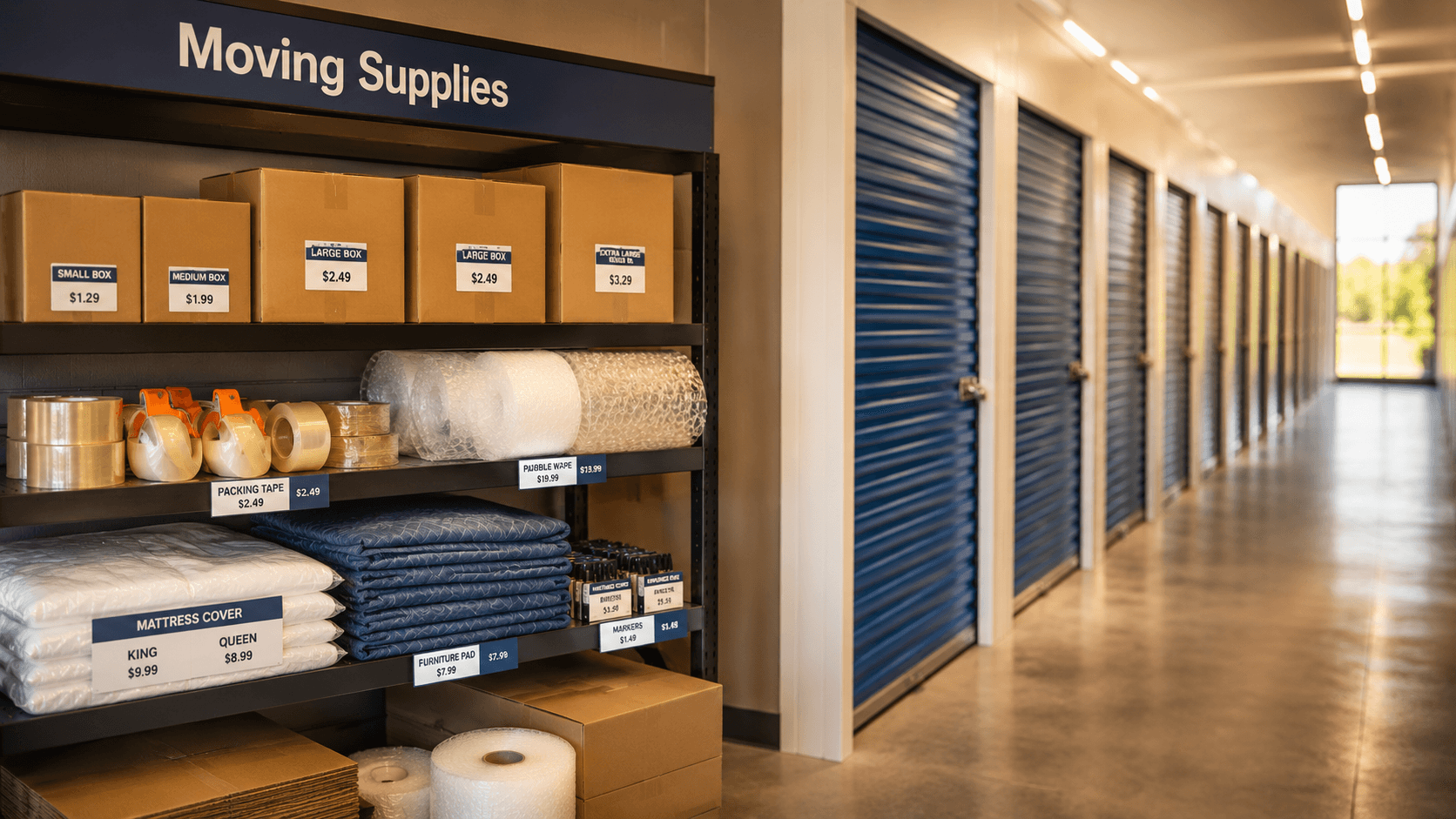
Walk into a typical self-storage office and you'll find a front counter, a couple of chairs, a brochure rack, and a half-empty rack of boxes shoved into a corner. The boxes look like an afterthought because they were one. Most operators set up retail once when the facility opened and haven't really thought about it since.
That's a missed opportunity. Tenants who are renting a storage unit are, by definition, in the middle of moving stuff. They need boxes. They need tape. They need a lock. If you've already got them in your office, the friction of selling them what they need is almost zero. The friction of letting them drive to U-Haul or Home Depot is where your money walks out the door.
1. Why Moving Supplies Are Better Margin Than You Think
Three things make moving supplies one of the most efficient ancillary revenue streams in the business.
- Captive customer. Every new tenant is, by definition, a moving supplies customer. They didn't drive to your office to NOT buy boxes. Conversion rates on a properly stocked, properly displayed retail program are dramatically higher than any other channel that sells the same products.
- High margin. Moving supplies marked up retail run 40 to 70 percent gross margin in most categories. Boxes alone are often 50 to 60 percent. Locks can be even higher.
- Almost zero operational overhead. Your manager is already there. Your point of sale is already set up. The shelves take maybe two hours a month to restock and tidy. Compare that to the labor required to generate the same revenue from another rental.
Add it up and a $10,000 retail year on a $300,000 revenue facility is a 3.3 percent revenue lift at higher than facility-average margin. That's a meaningful contribution to NOI for almost no extra work.
2. The Numbers: What a Real Retail Program Generates
Industry benchmarks land in a tight range.
- Retail revenue per rental: 1 to 4 percent of the rental value, depending on how aggressively the operator merchandises and how the move-in kits are priced (Storable, 2025).
- Retail as a share of total facility income: 3 to 5 percent at well-run facilities (Inside Self-Storage).
- Ancillary income overall (including retail, tenant insurance, fees, parking): 7 to 10 percent of total income at facilities that take it seriously (Inside Self-Storage).
The 2025 industry context makes this even more important. With rental rate growth softening across the industry, ancillary revenue is one of the few levers operators can pull without depending on the broader market (SkyView Advisors Q2 2025). Retail is the easiest of those levers to start moving today.
3. What to Stock
You don't need to carry hundreds of SKUs. A focused selection that covers what tenants actually need beats a sprawling inventory every time.
The Core SKUs (Must-Stock)
- Small, medium, and large boxes. The three sizes most tenants need. Stock heavier than you think you'll need, especially during peak moving months.
- Wardrobe boxes. Higher price point, higher margin, and one of the items tenants almost always need to buy from you because they're awkward to get elsewhere.
- Dish boxes / cell pack inserts. Specialized boxes for fragile items. Higher margin and they signal that you understand moving.
- Packing tape. Stock in small quantities (2-pack, 6-pack). Refill purchases happen regularly.
- Bubble wrap and packing paper. Both. They serve different purposes and tenants who buy one often need the other.
- Disc and cylinder locks. Higher quality than the cheap padlocks at the hardware store. Required reading for anyone who's seen a unit broken into.
- Furniture covers and mattress bags. Especially for non-climate-controlled facilities where dust and pests are concerns.
The Margin Add-Ons
- Moving blankets
- Stretch wrap
- Furniture sliders
- Tape dispensers
- Markers (Sharpies, sold individually or in 2-packs)
- Box cutters
- Hand trucks for purchase or rental
Skip These
- Anything that takes more than 90 days to sell. Tying up cash in slow-moving inventory is the most common retail mistake operators make.
- Specialty items only one tenant a year would buy. If it doesn't move, it's just collecting dust.
- Branded merchandise (mugs, t-shirts). Cute, but they don't sell.
4. Pricing and Margins
The pricing rule is simple. Be at or slightly below the price tenants would pay at U-Haul or Home Depot for comparable items, but never below your wholesale cost plus 50 percent.
Some rough margin targets to aim for:
- Boxes: 50 to 60 percent gross margin
- Tape and packing supplies: 50 to 70 percent
- Locks: 60 to 80 percent (the cheap stuff is very cheap wholesale)
- Bubble wrap, paper, blankets: 40 to 60 percent
- Move-in kits (bundled): 45 to 55 percent overall (the bundle discount slightly reduces margin but increases attach rate)
Don't overthink price testing. The customer comparison set is U-Haul and big box stores. Match those prices and you'll be fine. Going lower leaves money on the table. Going higher kills conversion.
5. Display: Make Your Office Look Like a Store
This is where most operators fall down. The retail program isn't broken because the products are wrong. It's broken because the office doesn't look like a store.
The 75/25 Rule
The conventional rule of thumb is to dedicate roughly 75 percent of your office floor space to merchandise and 25 percent to management comfort (Storelocal). Most facility offices are reversed: a giant counter, a couch, a coffee table, and a sad little box rack in the corner. Flip the ratio.
Display Fundamentals
- Eye level matters. Put your highest margin items at adult eye height. Put bulk items lower.
- Pricing on every item. No exceptions. A customer who has to ask the price will often just leave instead.
- Signs over each section. "Boxes," "Tape and Packing," "Locks." Treat your office like an actual retail aisle.
- Bundle displays. Group what tenants need together. A "Studio Apartment Move-In Kit" displayed as a complete bundle sells better than the same items scattered across the room.
- Restock daily. An empty shelf says "out of business." Top off display shelves every morning.
6. Move-In Kits: The Highest Conversion Item
Move-in kits are the single highest-leverage product in the entire retail program. Bundle the supplies a typical tenant needs, give it a sensible discount versus buying the items individually, and present it at sign-up.
A typical kit lineup:
- Studio / 5x5 kit: 10 small boxes, 5 medium boxes, 1 wardrobe, tape, paper, lock. Around $45 to $65 retail.
- 1-Bedroom / 5x10 kit: 15 small, 10 medium, 5 large, 2 wardrobes, tape, bubble wrap, paper, lock. Around $90 to $130.
- 2-3 Bedroom / 10x10 or larger: Scaled up box count, multiple wardrobes, more packing materials, lock. Around $150 to $250.
Every move-in conversation should include "do you need any moving supplies today?" with a printed kit menu. The conversion rate when the kit is offered conversationally is meaningfully higher than when tenants have to discover the retail rack on their own.
7. Outdoor Visibility: Tell People You Sell This Stuff
A lot of people who need boxes don't think to look at a self-storage facility for them. They think U-Haul, Home Depot, maybe Amazon. You have to tell them.
- Outdoor sign or banner mentioning "Boxes & Moving Supplies." Even a simple A-frame near the entrance generates walk-in retail traffic from people who weren't planning to rent a unit.
- A box display out front. A small stack of branded boxes near the entrance signals retail in a way no sign can match.
- Mention moving supplies in your Google Business Profile. List products in the services section. People search for "moving boxes near me" all the time, and if your profile mentions it, you'll show up.
- Add a moving supplies page to your website with the product list and pricing. Doubles as SEO content for terms tenants and non-tenants both search.
8. Sourcing: Where to Buy Wholesale
The wholesale side of moving supplies is well-developed. The major players that serve self-storage operators directly include:
- Storage industry distributors (companies like Chateau Products, Supply Side USA, and Cubic Supplies) that specialize in self-storage retail and offer everything from boxes to locks to display fixtures.
- National box manufacturers like Uline for general moving supplies. Higher minimums but very competitive pricing at scale.
- Lock specialists for higher-quality disc and cylinder locks. Going through a specialist beats reselling whatever Amazon ships you.
Avoid sourcing through general retail channels (Amazon, Costco). Margins disappear and you can't compete on price with the original retailer.
For a curated list of moving supply vendors that work with self-storage facilities, browse the StorageOwnerAdvisor moving supplies directory.
9. Common Mistakes
Mistake 1: Treating Retail as a Side Project
The operators who succeed at retail treat it as a discrete business unit with its own metrics: monthly revenue, gross margin, attach rate at move-in, inventory turn. Track these. Review them. Otherwise the program drifts and the shelves get dusty.
Mistake 2: Overstocking
Too much inventory is the second most common mistake. Every dollar tied up in slow-moving boxes is a dollar not in the bank. Order more often, in smaller quantities, until you understand what actually moves.
Mistake 3: No Price Tags
If a customer can't see the price without asking, half of them won't ask. Price every item, every time.
Mistake 4: Not Mentioning Supplies at Sign-Up
The single highest-converting moment for retail is the new tenant sign-up. If your manager isn't asking about supplies in that conversation, you're losing 50 to 70 percent of potential sales right there.
Mistake 5: Skipping Outdoor Visibility
People who need boxes don't drive past your facility looking for them. You have to advertise. A small outdoor sign costs almost nothing and pays for itself in a month.
The Bottom Line
Moving supplies are not a glamorous part of the storage business. They are, however, one of the easiest ways to add real margin to a facility. The infrastructure is already there. The customers are already in your office. The work to set up a real retail program is finite. And the upside is anywhere from 3 to 5 percent of total facility income at margins above your facility average.
Stock the right SKUs. Display them like an actual store. Bundle them into move-in kits. Tell people outside that you sell them. Restock weekly and review the numbers monthly. Owners who run their retail program this way are quietly putting thousands of dollars a year in their pocket. Owners who keep treating it as an afterthought are leaving that money on the table for a competitor or for U-Haul.
Sources: Inside Self-Storage: Ancillary Sales to Increase Self-Storage Revenue, Inside Self-Storage: Ancillary Acceleration, Inside Self-Storage: True Ancillary Income, Storable: Six Ways to Increase Revenue Per Self-Storage Tenant (2025), SkyView Advisors Q2 2025 Self-Storage Industry Report, Storelocal: 10 Self Storage Products to Offer and How to Market Them Like a Retailer.
Looking for Moving & Packing Supplies vendors?
Browse our directory of trusted moving & packing supplies providers for storage facilities.
View Moving & Packing Supplies Vendors