Signage and Lighting for Self-Storage: The Curb Appeal Investment That Pays Back
Signage & Lighting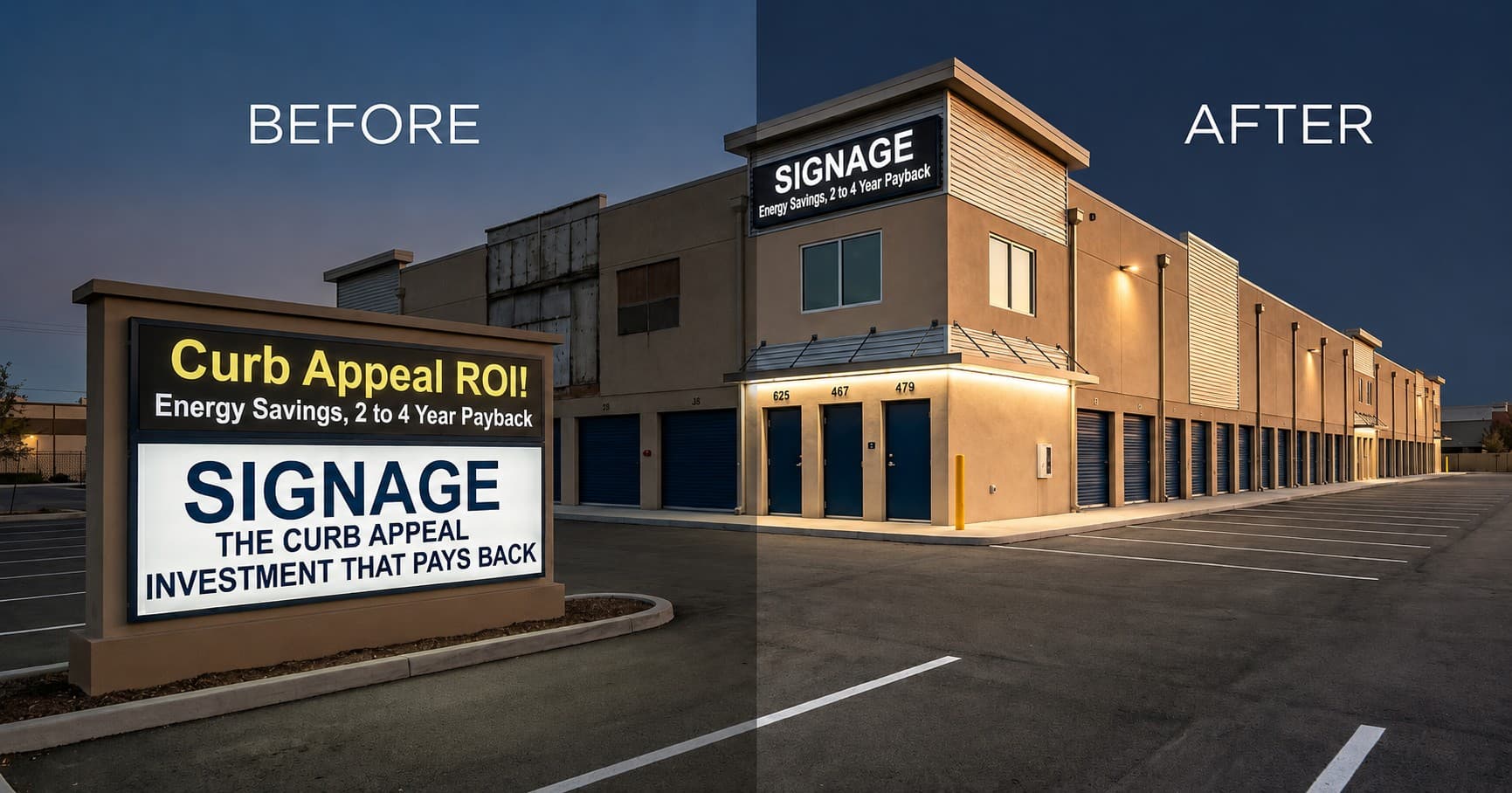
Most facility owners spend hours optimizing their Google Business Profile and almost no time thinking about their monument sign or their parking lot lights. That's backwards. The website gets you found. The sign and the lights at the property close the deal.
If 80 percent of your customers either find you online or drive past your gate, then your sign and your lighting are doing the same job your website is doing. They're either making the case for your facility or quietly handing leads to the operator down the street.
1. Why Signage and Lighting Are a Marketing Channel
Self-storage isn't an impulse purchase, but it is often a quick decision. Someone in the middle of a move, a divorce, or a downsizing event decides they need storage and they need it now. They Google "storage near me," scroll a few options, and either book online or drive past a few facilities to take a look.
That's where signage and lighting earn their keep.
- 37 percent of people report looking at a sign every time they pass one. Position yours where it's visible to drivers, and you've put your facility in front of a meaningful share of the local market for free, every day (Asset Growth, 2025).
- Lighting is what makes you the safe choice at night. A tenant who needs to grab something at 9 PM and finds your property dim or shadowed isn't just unhappy. They're considering a competitor with brighter lighting next time their lease comes up.
- Curb appeal compounds online too. The same well-lit, well-signed property shows up better in Google Street View and in the photos tenants leave with their reviews.
2. Exterior Signage: What Works and What Doesn't
Your exterior signage has one job: communicate that this is a self-storage facility, give the brand name, and make both readable from a moving vehicle. Anything beyond that is a bonus.
The Main Sign
- Position it for drivers, not for the property. The sign should be visible to traffic in both directions on the road, not just to people already turning into your driveway.
- Lit at night, every night. An unlit sign is a closed sign as far as a driver at 7 PM is concerned. Internal illumination or a properly aimed external floodlight, either works.
- Large, readable type. Big block letters, high contrast, no decorative fonts. A driver has about two seconds to read it.
- Brand name plus "Self Storage." Don't make people guess what you do.
LED Electronic Message Centers (EMCs)
An outdoor LED EMC, the kind that scrolls or rotates messages, is one of the most productive advertising tools in self-storage when local code allows it (Inside Self-Storage). You can run move-in specials, holiday hours, climate-controlled availability, and seasonal promos without printing a thing.
Two caveats. First, EMCs are tightly regulated in many jurisdictions, with rules on brightness, message dwell time, and animation. Check your local sign code before you spec one. Second, an EMC running stale or generic messages is worse than no EMC at all. Build a content rotation and update it monthly.
Materials That Actually Last
- Outdoor signs should be aluminum or aluminum composite, not steel (steel rusts and stains).
- Printed graphics need a UV-resistant cast laminate. That's what gets you 5+ years of color life instead of fading in 18 months.
- Clean signs with a soft cloth and minimal soap and water. Pressure washing damages the laminate (Inside Self-Storage).
3. Interior and Wayfinding Signage
Once a tenant is on the property, signage stops being a marketing tool and starts being an operations tool. Done well, it cuts down on phone calls, lost tenants wandering the property, and confusion at move-in. Done poorly, it makes your facility feel cheap.
- Unit numbers in consistent size and placement on every door. Big enough to read from across the corridor.
- Building letters on the corner of each building, large enough to see from the gate.
- Directional signs at every intersection inside the property. To the office, to specific buildings, to the loading area, to the elevator.
- Map signs with "you are here" markers at key decision points. Tenants love these. Multi-building facilities especially.
- Hours and access info at the gate and at the office.
- Required signage for emergency exits, restrooms, and any local code requirements.
If you're refreshing your interior signage, add QR codes that link to your website, the tenant portal, or a contact page. Costs almost nothing and quietly drives self-service.
4. The LED Lighting Retrofit Math
If you're still running fluorescent or HID (high-intensity discharge) lights anywhere on your property, this section is the most valuable thing in the article.
Why the Math Works
- Energy. LED uses 60 to 90 percent less power than the lighting it replaces. On a facility with hundreds of fixtures running every night, the monthly savings are immediate and sizable.
- Maintenance. LED fixtures last 50,000 to 100,000 hours. You stop replacing bulbs every few months. That's labor savings on top of energy savings.
- Quality. LED runs cooler, comes on instantly (no warmup like HID), and produces a cleaner, whiter light that makes the property look better and feel safer.
- Insurance. Some carriers offer small premium discounts on facilities with upgraded lighting. Worth asking.
Rebates and Tax Incentives Make It Cheaper
- Utility rebates from your local power company often cover 30 to 70 percent of an LED retrofit. Most utilities have programs specifically for commercial lighting upgrades. Call yours and ask before you spec the project (HyLite LED, 2026).
- The 179D Commercial Buildings Energy-Efficiency Tax Deduction can knock real dollars off your tax bill if your retrofit hits the energy reduction thresholds. Talk to your accountant before the project starts so you can document everything correctly.
- Combined rebates and tax incentives can drop a 3 year payback to under 12 months on the right project.
Where to Retrofit First
Not every fixture saves the same amount. Prioritize in this order:
- Exterior pole lights and wall packs. These run all night every night and are usually the worst offenders on energy use.
- Corridor and hallway lights inside climate-controlled buildings. Often on 24/7 or motion-triggered.
- Office and reception. Lower priority but usually a quick win.
- Inside individual units (if applicable). Last priority since most units don't have lights, and the ones that do are rarely on.
5. Security Lighting Specifically
Security lighting is where signage and lighting overlap most clearly. It deters break-ins, supports your camera footage, and tells tenants the property is monitored. The bar to clear is higher than just "lit."
- The entire perimeter should be lit after dark. No shadowed corners.
- Motion-activated lights in lower-traffic areas. They draw attention to movement and save power between events.
- Match lighting to your camera coverage. A camera pointed at a dim corner produces useless footage. Walk your property at night and look for spots where the camera can see but the light can't.
- Color temperature matters. Cooler white light (4000K to 5000K) reads as "secure" and works better with cameras than warm yellow light. Warmer tones (3000K) feel more residential, which is fine for the office area but wrong for the perimeter.
- Replace burnouts immediately. A single dark fixture in a row of working lights signals "neglected property" to anyone watching.
6. Local Sign Code, Permits, and What You Can Actually Build
The biggest budget surprise on a signage project usually isn't the sign. It's discovering after you've ordered it that local code limits sign height, total square footage, animation, brightness, or distance from the road.
Before you spec anything, get answers to these questions from your municipality.
- What's the maximum sign area allowed for my property's zoning?
- What's the maximum sign height?
- Are LED EMCs allowed? If so, are there brightness limits, dwell time requirements, or animation restrictions?
- Are illuminated signs allowed? Internal illumination only, or external too?
- What's the setback requirement from the road?
- Do I need a permit, and what's the timeline?
- Are there sign code variances available, and what's the appeal process?
Self-storage development and zoning continues to be a moving target in many jurisdictions (Inside Self-Storage). What was approved for a competitor five years ago may not be approved today.
7. Common Mistakes
Mistake 1: Spending on the Wrong Sign
A beautiful, custom monument sign tucked behind landscaping where drivers can't see it is wasted money. Visibility beats aesthetics every time. If you have to choose, choose the spot drivers will actually see.
Mistake 2: Skipping the LED Retrofit
Owners who put off LED conversion because the upfront cost feels high are paying for that decision in their power bill every single month. Run the numbers with rebates included. The payback is almost always shorter than you expect.
Mistake 3: Letting Signs Fade
Faded, peeling, or sun-bleached signage tells everyone driving by that the facility isn't being maintained. Replace any sign that's lost its color. The cost is low and the perception swing is huge.
Mistake 4: Lighting Holes That Make Your Cameras Useless
Cameras and lighting need to be planned together, not separately. The number of facility owners who have a great camera system and dark spots in the camera's field of view is depressing. Walk the property at night and fix the gaps.
Mistake 5: Ignoring Wayfinding
If new tenants regularly call the office asking how to find their unit, your interior signage is broken. Add directional signs and a property map. Phone calls drop, satisfaction goes up.
8. Vendor Selection
The right vendor depends on what you're buying.
- Sign vendors: Look for self-storage experience specifically. They'll know your typical layout, what works for unit numbers and wayfinding, and which materials hold up in your climate.
- Lighting contractors: Get bids from at least two. Ask each one to model the project with utility rebates and 179D included. The contractor who can't speak to the incentive math probably hasn't done many of these projects.
- Permit and code consultants: If your sign project is complex or your municipality is restrictive, a small upfront fee for a consultant who knows the local code can save you from ordering something you can't install.
For sign and lighting vendors that work with self-storage facilities, browse the StorageOwnerAdvisor signage and lighting directory.
The Bottom Line
Signage and lighting are easy to ignore because they don't show up as a line item on a marketing report. They are, however, doing marketing work every minute of every day. A clean, well-lit, well-signed facility converts more drive-by traffic, retains tenants longer, and trades for a higher cap rate when you sell. A facility with faded signs and a dim parking lot does the opposite, no matter how good the website is.
Make the investment. Get the LED retrofit done. Replace the sign that's been faded for two years. Walk the property at night and write down every dark spot. The work is finite. The payoff compounds.
Sources: Storage Commander: Customer Acquisition and Digital Marketing for Self-Storage (2025), Asset Growth: Self Storage Sign Ideas (2025), Inside Self-Storage: Designing Powerful Signage for Self-Storage Facilities, Inside Self-Storage: Self-Storage Sign Care, Radius+: Maximize Profitability: How LED Lighting Reduces Costs for Self-Storage (2025), HyLite LED Lighting: LED Lighting for Self-Storage Facilities (2026), Inside Self-Storage: Self-Storage Development and Zoning, December 2025.
Looking for Signage & Lighting vendors?
Browse our directory of trusted signage & lighting providers for storage facilities.
View Signage & Lighting Vendors