Self-Storage Cleaning and Maintenance: The Daily, Weekly, and Annual Playbook
Cleaning & Maintenance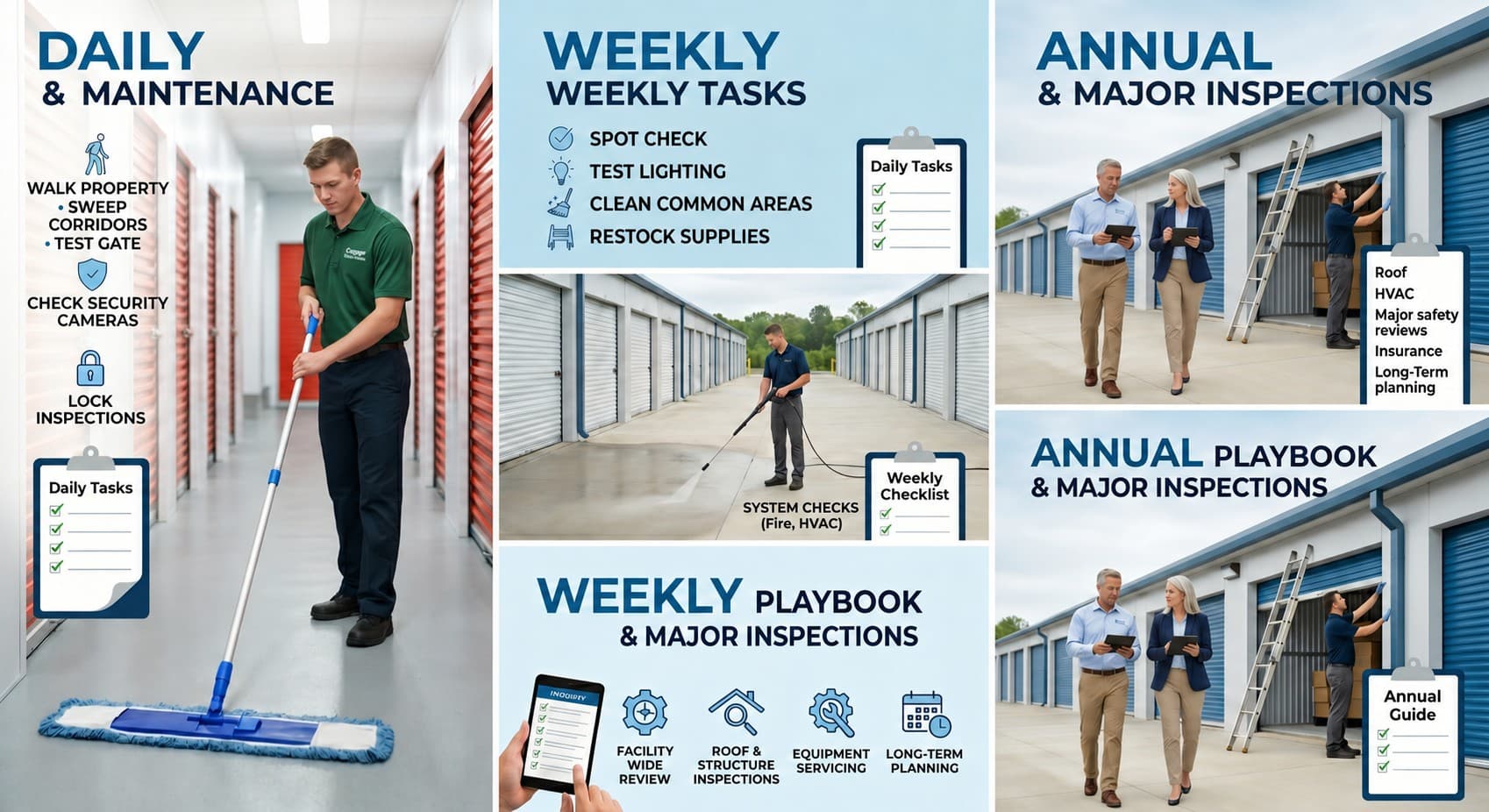
Self-storage is a deceptively physical business. The software is sophisticated. The marketing is digital. Most of the customer experience is automated. Then a tenant pulls up to the gate, looks at the property, and decides in about ten seconds whether to keep their reservation or drive to your competitor.
That ten second judgment is mostly about cleanliness and condition. Stained pavement. Weeds in the cracks. A rusty roll-up door. Trash in the corner of the corridor. Any one of those can kill a sign-up before the tenant ever talks to your manager.
Cleaning and maintenance isn't a back office function. It's a leasing tool, a retention tool, and the single biggest reason your facility either holds its value over time or quietly decays.
1. What Maintenance Actually Buys You
Three things make maintenance one of the highest ROI activities in the entire industry.
- Higher conversion at the gate. First impressions sell units. Cleanliness shows up consistently in customer reviews as a top factor when tenants pick a facility, and a clean, well-kept property converts more drive-by traffic than any marketing campaign.
- Longer tenant stays. The data shows tenants are staying longer than ever. The owners holding tenants past the 19 month average are the ones whose facilities still feel like a place worth paying for in month 20.
- Stronger reviews and a higher star rating. Reviews drive new sign-ups. Cleanliness and condition are the two things tenants mention most often. A well-maintained facility quietly compounds review momentum every month.
2. The Real Cost of Cutting Corners
Industry benchmarks put annual maintenance spend at $0.10 to $0.25 per square foot for cleaning, minor repairs, repainting, and pest control (Titan Steel Structures, 2025). For a 50,000 square foot facility, that's $5,000 to $12,500 a year.
That's the cost of doing it right. The cost of skipping it is much higher, and it lands all at once.
- A roof leak caught on the next inspection: a few hundred dollars in patching.
- The same leak caught after it ruins a tenant's belongings: an insurance claim, a lawsuit risk, a lost tenant, a one star review.
- A pest issue caught at a quarterly visit: a $300 service call.
- A pest issue that gets out of hand: thousands in remediation, mass move-outs, and a reputation that takes a year to rebuild.
Maintenance is one of the few areas of running a facility where small, consistent spending prevents disproportionately large losses. The math is almost always in your favor (Inside Self-Storage, 2025).
3. The Daily, Weekly, Monthly, and Annual Schedule
The owners who run their facilities cleanly all run some version of this schedule. The exact tasks vary by property, but the cadence is the same (Storeganise, 2026).
Daily
- Walk the entire property. The walk itself catches problems you'd never see from the office.
- Pick up trash and sweep walkways and hallways.
- Test the gate and keypad. Make sure both work and the keypad is clean enough to read.
- Look for safety hazards: hanging tree limbs, damaged fencing, uneven walkways, blown lights.
- Confirm all security cameras are recording.
Weekly
- Clean the reception area and any restrooms.
- Spot check vacant units for water intrusion, pest activity, or anything that shouldn't be there.
- Test exterior and corridor lighting after dark.
- Restock office and cleaning supplies.
Monthly
- Full security system test, including alarms and door sensors if you have them.
- Door function check on a rotating sample of units.
- HVAC filter check on climate-controlled buildings.
- Pest activity inspection (interior corners, vacant units, perimeter).
- Office tech and POS terminal check.
Quarterly
- Professional pest control visit.
- Roof and gutter inspection.
- HVAC professional service.
- Pavement and drainage inspection.
- Landscape trim, especially anything growing into fences or against buildings.
- Fire extinguisher and alarm test.
Annually
- Full HVAC system tune up before peak cooling season.
- Roof recoat or repair as needed (every 5 to 10 years on most materials).
- Repaint exterior trim, doors, and any high traffic interior surfaces.
- Full safety inspection top to bottom.
- Insurance walkthrough with your agent so coverage reflects current property condition.
4. Unit Turnover: The Most Overlooked Profit Lever
When a tenant moves out, the speed and quality of your turnover directly affects vacancy days and the next tenant's satisfaction. Owners who get this right have a written process and a 15 to 30 minute target per standard unit. If your manager can't turn a unit in that window, your process is broken or you don't have one (Moving Stories Foundation, 2025).
A Solid Turnover Sequence
- Inspect for damage. Photograph anything that's not normal wear and tear.
- Sweep the unit. Use a shop vac on crevices if you need to. Avoid soaking the interior with water.
- Wipe down door tracks and the locking mechanism.
- Test the interior light if there is one.
- Confirm walls and ceiling are intact and clean.
- Replace any damaged components (light, latch, weather seal).
- Mark the unit as ready in your management software so it goes back into the rentable pool immediately.
Every day a unit sits in "needs cleaning" status is a day of lost rent. Owners who track turnover time and treat it as a real metric consistently rent vacant units faster than owners who don't.
5. Climate-Controlled Facilities Need More
If you have climate-controlled space, your maintenance load goes up. The good news is that most of the extra work is predictable and easy to schedule.
- HVAC filters every 3 to 6 months. Dirty filters tank efficiency and shorten equipment life.
- Quarterly professional HVAC inspection covering refrigerant levels, electrical connections, and ductwork.
- Humidity monitoring with a target of under 60 percent relative humidity to prevent mold (Boxwell, 2025).
- Temperature logging so you have a record if a tenant ever claims the unit drifted out of range.
- Backup HVAC capacity wherever possible so a single failure doesn't take a whole building offline.
6. Pest Control: Run an Actual Program
The biggest pest control mistake is reacting instead of preventing. Calling an exterminator after a tenant complains is too late. By that point, the pest population is established, the damage to belongings has happened, and the review is already being typed.
The right approach is Integrated Pest Management (IPM). Done correctly, IPM focuses on prevention first and uses chemicals only when necessary. Most licensed providers can build an IPM plan around your specific property (Inside Self-Storage, 2025).
What a Real IPM Program Looks Like
- Quarterly inspections by a licensed pest management provider, with bait stations, pheromone traps, and infrared cameras for hidden activity.
- Sealed gaps around plumbing, electrical, and gas line penetrations.
- Intact door sweeps on every unit, office door, and corridor entrance.
- Screened windows and closed doors when not in use.
- Documented response protocol when activity is detected, so it doesn't get ignored.
What Your Staff Should Watch For
- Visual sightings of pests during walkthroughs.
- Fecal droppings, especially along walls and in corners.
- Gnaw marks on packaging, cables, or door seals.
- Nests in vacant units or low traffic corridors.
- Strange noises in walls or ceilings, especially at night.
- Oily tracks or rub marks where rodents repeatedly travel.
Train your staff to identify the signs and to document and report immediately. A quarterly visit plus alert staff catches almost every problem before it spreads.
7. Roof, Pavement, and Structural
The expensive maintenance items live here. They're also the items most likely to get deferred until they fail.
Roof
- Inspect for missing shingles, pooling water, and obvious leaks every quarter.
- Clear gutters and downspouts so water actually drains.
- Recoat metal roofs every 5 to 10 years depending on material and climate.
- Address every leak immediately. A small leak gets bigger every storm.
Pavement and Drainage
- Crack seal annually before water freezes inside the cracks and breaks them open.
- Sealcoat every 3 to 5 years.
- Patch potholes immediately. They don't fix themselves.
- Watch for water pooling near unit doors, which means the drainage isn't working and your tenants' belongings are at risk.
Doors and Hardware
- Inspect roll-up doors for dents, alignment issues, and damaged seals.
- Lubricate door tracks and locking mechanisms regularly.
- Replace weather seals to prevent water and pest entry.
- Test any individual unit alarms or door sensors.
8. In-House vs Outsourced
Most of the daily and weekly work belongs in-house. Most of the quarterly and annual work belongs to a specialist. The trick is knowing which is which (Peer Storage, 2025).
Keep In-House
- Daily walkthroughs and trash pickup.
- Weekly cleaning of office and restrooms.
- Light landscape work (mowing, edging, weed pulling).
- Lightbulb replacement.
- Door track lubrication.
- HVAC filter changes.
- Unit turnover.
Outsource to a Licensed Specialist
- Pest control. Always use a licensed provider with IPM experience.
- HVAC service and repair.
- Roof inspection and repair.
- Pavement work.
- Annual safety inspections.
- Anything that requires a license, special equipment, or its own insurance.
9. Software That Actually Helps
Modern storage management software has built-in maintenance tracking that turns a clipboard process into a system.
- Recurring task lists for daily, weekly, monthly, and quarterly checks.
- Work order management so issues found during a walkthrough get assigned, tracked, and closed out.
- Photo documentation attached to each task, which is gold when you need to show insurance or a buyer how well the property has been maintained.
- Vendor coordination, so quarterly pest visits, HVAC service, and roof inspections show up on the calendar instead of slipping.
- Reporting on completion rates, work order turnaround time, and recurring issues.
If you're tracking maintenance on paper or in your head, you're missing things. The cost of any decent management platform is paid back the first time you avoid a single major issue because the system flagged it early.
10. The Bottom Line
Maintenance compounds. The owner who runs a tight program for 10 years has a facility worth substantially more than the same facility run loosely. At sale, buyers and brokers can read deferred maintenance the moment they step out of the car. Cap rates shift by quarter points based on what they see.
Run the daily walkthrough. Do the weekly checks. Hit the quarterly and annual cycles. Track everything in software. Outsource what needs a licensed pro. The cost of running a real maintenance program is small. The cost of skipping it shows up in lost tenants, bad reviews, expensive repairs, and a lower sale price every single time.
For vendors that handle cleaning, janitorial service, pest control, pavement, roofing, and the rest of facility maintenance, browse the StorageOwnerAdvisor cleaning and maintenance directory.
Sources: SkyView Advisors Q3 2025 Self-Storage Industry Report, Storeganise Self-Storage Maintenance Checklist 2026, Inside Self-Storage: The Self-Storage Maintenance Mindset (2025), Inside Self-Storage: Pest-Control Best Practices (2025), Boxwell / Storeganise 2025 Maintenance Checklist, Moving Stories Foundation: Unit Turnover Best Practices (2025), Peer Storage Maintenance Checklist 2025, Titan Steel Structures (2025).
Looking for Cleaning & Maintenance vendors?
Browse our directory of trusted cleaning & maintenance providers for storage facilities.
View Cleaning & Maintenance Vendors